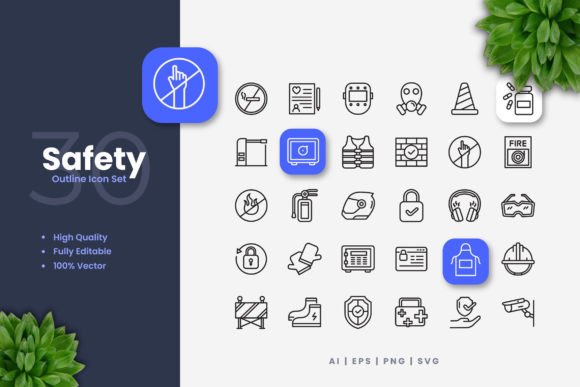
Safety Icons: Communicating Security Clearly
Imagine needing to warn someone about a hazard, guide them toward an emergency exit, or indicate a safe procedure. Words can work, but a well-designed icon often communicates faster and more universally. Safety icons are a specialized set of visual symbols designed to convey critical information about safety, hazards, precautions, and emergency protocols. Their main purpose is to communicate clearly and immediately, transcending language barriers and ensuring vital messages are understood at a glance.
The Value of a Simple and Clean Design Approach
When dealing with safety information, clarity is paramount. A simple and clean icon design eliminates visual clutter, allowing the core message to shine. This aesthetic isn't just about looking modern; it’s about functionality. Overly complex icons can confuse or slow down recognition, especially in urgent situations or when viewed from a distance. A clean design with clear outlines and intentional shapes ensures the icon is legible and effective across a wide range of applications.
This approach holds significant appeal for creators and professionals. A minimalist icon set integrates seamlessly into diverse projects without competing with other visual elements. It provides a professional, authoritative tone that reinforces the seriousness of the safety message you're conveying.
Who Benefits from These Icons and Why?
You might be interested in a collection of safety icons if your work or projects involve communicating rules, warnings, or instructions. This spans many roles. A small business owner creating safety manuals for their workshop, a blogger writing about workplace best practices, an educator developing instructional materials for a science class, or a marketer designing a campaign for a security product—all might find these icons invaluable.
They solve a common problem: the need for professional, consistent safety visuals without the time and cost of custom illustration. For a freelancer or hobbyist building a website for a community center, having ready-to-use icons for their safety guidelines page speeds up the project dramatically. The goal is to enhance communication and compliance, and a reliable icon set supports that need directly.
Practical Applications Across Mediums
The utility of these icons is broad thanks to their adaptable design. Their clean nature makes them perfect for digital interfaces like websites and mobile apps, where they can serve as intuitive buttons or indicators for safety features. In print media—books, flyers, posters, and banners—they maintain their integrity whether printed large on a factory wall or small in a booklet.
Consider a real-world use case: an entrepreneur launching a new fitness app. Including clear icons for proper equipment use or hydration reminders within the app interface improves user experience and safety. An educator might use them in an infographic about lab safety for students, making the rules visually engaging and easy to remember. For social media posts promoting a public safety campaign, these icons can be the focal point of a graphic, conveying the message instantly as people scroll.
Key Features for Maximum Flexibility
A truly useful icon set is not just about the design but also about the technical delivery. The mentioned features like being 100% vector-based are crucial. Vector graphics are defined by mathematical points and lines, not pixels. This means you can resize them infinitely—from a tiny app button to a massive banner—without any loss of quality or sharpness.
The editable stroke weight allows you to adjust the thickness of the icon lines. You might want thicker strokes for a bold poster and thinner, more delicate strokes for a sleek website integration. The ability to change color is fundamental for brand alignment or coding different hazard levels. This level of customization means the icons can adapt to your specific project’s aesthetic and functional requirements, not the other way around.
Understanding the Included Files
The provided file formats each serve a distinct purpose, enabling work across different software and platforms. The AI source file and EPS version 10 are standard for professional vector editing software like Adobe Illustrator or CorelDRAW. Here, you can perform deep edits, change colors, or extract individual elements. The SVG file is a web-friendly vector format ideal for modern websites and digital applications, ensuring crisp display on any screen.
The PNG files with transparency are raster images, useful for quick drag-and-drop into situations where vector editing isn't needed, like some presentation software or basic image editors. They are ready to use with a transparent background for easy layering. The readme file typically contains important instructions or a legend explaining each icon's meaning, which is essential for proper use. Remember, as noted, a preview mockup showcasing the icons in a staged scene is not part of the package; you receive the core graphic assets for your own implementation.
Important Considerations Before Use
While the technical flexibility is a major advantage, effective use of safety icons requires some consideration. First, ensure you understand the standard meaning of each symbol. Misusing a safety icon can lead to confusion or even danger. The included legend or your own research is vital. Secondly, even with editable colors, it’s wise to adhere to conventional color associations where appropriate—like red for warnings or green for safe actions—to leverage existing public understanding.
Also, assess your own toolset. The full customization potential is unlocked with vector software like Illustrator or CorelDRAW. If you don’t use such software, you can still utilize the PNG or SVG files, but your ability to edit stroke weight or reshape elements will be limited. Finally, always test the icons in their final context. Place them on your actual flyer draft or app prototype to check for legibility and visual harmony with your overall design.
In essence, a well-crafted set of safety icons with a simple and clean design is more than a graphic asset; it’s a communication toolkit. It empowers you to convey important safety messages with clarity, speed, and visual consistency, supporting your goals across professional, educational, and creative endeavors.