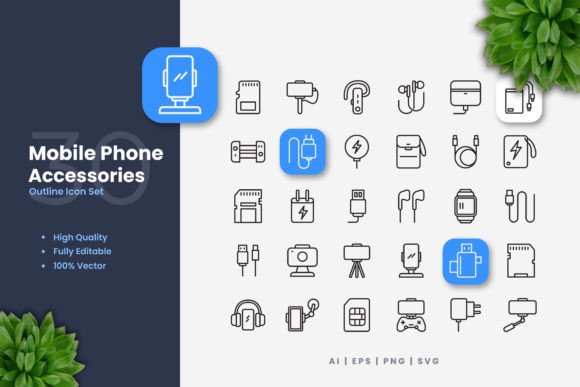
The Essential Role of Phone Accessories Icons in Modern Digital Design
In the visual landscape of digital interfaces, small graphical representations carry immense communicative power. Among these, icons dedicated to phone accessories have become a fundamental element, serving as universal shorthand for a wide array of functions and products. These symbols, depicting items like headphones, chargers, cases, and cables, transcend language barriers and streamline user interaction across countless platforms. Their design, particularly when executed in a simple and clean style, is not merely an aesthetic choice but a functional necessity for clarity and quick comprehension.
The Anatomy of Effective Phone Accessories Icons
Creating an effective set of phone accessories icons requires a balance between recognizability and stylistic consistency. The core characteristic of a successful icon is its ability to be instantly understood. A user should immediately recognize a stylized battery icon as representing power or charging, or a pair of earbuds as denoting audio settings or headphone connectivity. This is achieved through the use of common, simplified visual metaphors that have been established through widespread use.
The trend towards simple and clean icon design is driven by the need for scalability and versatility. A minimal design, often using precise lines and solid shapes, ensures the icon remains clear and uncluttered when displayed at various sizes—from a tiny app button to a large poster graphic. This simplicity also aids in aesthetic cohesion when icons are grouped together, creating a unified visual language for a project. Overly detailed or ornate illustrations of phone accessories can become indistinct at smaller sizes and may clash with a modern, minimalist interface.
Vector Format: The Foundation of Flexibility
The true utility of a well-designed icon set lies in its technical construction. When icons are provided as vector files—such as the industry-standard AI, EPS, or SVG formats—they become infinitely adaptable assets. Vector graphics are defined by mathematical paths and points, not pixels. This means they can be resized to any dimension, from a thumbnail to a billboard, without any loss of quality or sharpness. The edges remain crisp, and the shapes remain precise.
This vector basis is what makes the promise of customization fully achievable. Designers or end-users can open these files in software like Adobe Illustrator or CorelDRAW and freely edit every aspect. Changing the color palette to match brand guidelines is a matter of selecting and filling paths. Adjusting the stroke weight—the thickness of the lines composing the icon—can alter its visual prominence and style, making it appear more bold or delicate. Individual elements within a complex icon, like a detail on a phone case graphic, can be modified or removed. This level of control is impossible with static, pixel-based formats like standard JPEGs.
Diverse Applications in the Real World
The application of phone accessories icons extends far beyond the screen of a smartphone. Their utility is a key reason for their widespread demand.
- Websites and Mobile Apps: These are the most common environments. Icons are used for navigation menus (a charger icon for "support" or "accessories" sections), feature lists (a Bluetooth icon to denote wireless compatibility), and e-commerce categories (visual guides for shoppers looking for specific accessories). Their use significantly improves user experience by speeding up navigation and reducing textual clutter.
- Educational Materials and Infographics: Educators and content creators use these icons to visually explain technology concepts, illustrate the components of a mobile device ecosystem, or create engaging instructional materials. A clean icon of a charging cable is more effective than a paragraph describing one in a diagram about phone power management.
- Print and Physical Media: The scalability of vector icons makes them perfect for flyers, brochures, banners, and posters. A company promoting a new line of phone cases can use a stylized, elegant case icon across all its marketing materials, from a small flyer to a large trade show poster, ensuring brand consistency.
- Books and Publications: Technical manuals, consumer guides, and textbooks utilize these icons to break up text and provide visual references, aiding in reader understanding and retention.
- Social Media and Digital Marketing: Customizable icons are used in creating branded graphics for social posts, email campaign headers, and online advertisements to quickly convey the topic—be it a sale on headphones or a tutorial on using a new accessory.
Workflow Integration for Professionals and Hobbyists
For a graphic designer working on a client's app, receiving a pack of phone accessories icons in editable vector formats streamlines the workflow. Instead of painstakingly creating each icon from scratch, they can drag and drop the provided SVG or AI files directly into their layout. They then efficiently tailor them to the project's needs: resizing, recoloring, and perhaps simplifying them further. This efficiency saves hours of labor and allows focus on the broader creative composition.
Similarly, a hobbyist or small business owner with access to vector software can utilize these assets without deep design expertise. The easy drag-and-drop nature of the files, coupled with the ability to make simple color changes, empowers them to produce professional-looking materials for their website or product catalog. The inclusion of a PNG transparency file format offers immediate usability for those who need to quickly place an icon onto a digital background without any editing software.
Key Considerations When Selecting Icon Assets
When evaluating a set of phone accessories icons, several practical factors beyond the visual design should be assessed. The completeness and relevance of the set are crucial. Does it cover the full range of contemporary accessories, including older symbols like car chargers and newer ones like wireless charging pads or smartphone gimbals? A comprehensive set prevents the need to source missing icons elsewhere.
The technical specifications, as highlighted in the provided file list, are paramount. The presence of a source AI file is often considered the gold standard, as it preserves all editable layers and effects in Adobe Illustrator's native format. The EPS version 10 ensures compatibility with a wide range of legacy and modern vector programs. The SVG file is essential for web and interactive design, as it can be directly coded into websites and scaled dynamically by CSS. PNG files with transparency provide a ready-to-use bitmap fallback. A readme file, while simple, indicates proper packaging and may offer useful instructions on the icon set's structure or licensing.
It is important to note that a preview mockup, often a stylish image showing the icons in a simulated use case, is a presentation tool. Its absence, as mentioned, means the purchaser is evaluating the icons solely on their core files—the raw, editable assets. This focuses the decision purely on the design quality and technical utility of the icons themselves.
The Long-Term Value of a Quality Icon Set
Investing in a well-designed, vector-based set of phone accessories icons provides long-term value. As a project evolves or a brand refreshes its identity, the icons can be adapted rather than replaced. The same core icon of a smartphone dock can be rendered in neon colors for a youthful tech blog today and in muted, corporate tones for a business presentation tomorrow. This adaptability protects against obsolescence. Furthermore, the universal themes represented by phone accessories ensure these icons remain relevant across industries and projects, from a mobile phone repair shop's signage to a university's IT department website. Their simple and clean design philosophy aligns with enduring principles of good communication: clarity, efficiency, and aesthetic harmony.